Extensive Calculator for Regular and Scientific Calculations
Download App for Windows 10.0 and above, x64
If you have any issue with the app installation, or with the already installed app, please uninstall old versions and install latest version, by clicking above link
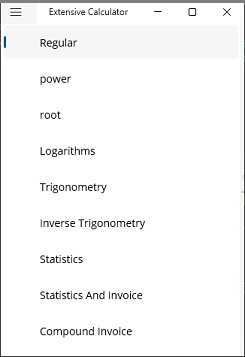
Regular calculations and scientific calculations
All regular calculations and scientific calculations, in easy-to-use interface, with accuracy upto more than 10 decimal points. Regular Core Functions : Addition (+): Combines two or more numbers to find a total sum.Subtraction (−): Finds the difference between numbers.Multiplication (×): Scales one number by another.Division (÷): Splits a number into equal parts.
Scientific Calculations include: Power Operations, any Root of any number , Trigonometry Functions ( sin, cos, and tan for angles) and Inverse Trigonometry Functions, Logarithms ( log for any base) and natural logarithms (base e).
Basic Arithmetic Operations
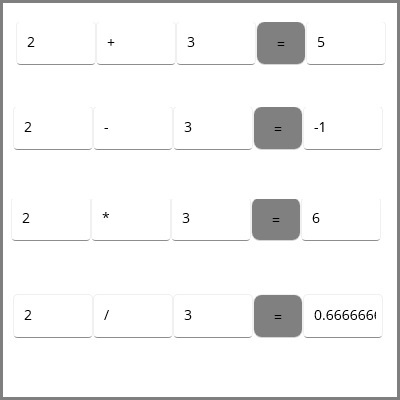 These basic mathematical operations (+, -, ×, and ÷) we use in our everyday life.
 The four basic arithmetic operations in Maths, for all real numbers, are:
Addition (Finding the Sum; ‘+’)
Subtraction (Finding the difference; ‘-’)
Multiplication (Finding the product; ‘×’ )
Division (Finding the quotient; ‘÷’).
You can perform all these operations with high accuracy upto more than 10 digits. The user friendly interface, helps users do calculations in familiar written format.
Powers and Exponents Calculations
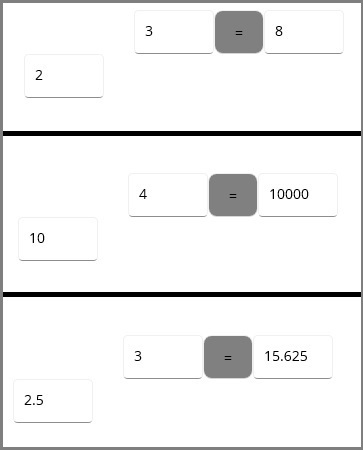 An expression that represents repeated multiplication of the same factor is called a power.
3 to the first power 3
4 to the second power or 4 squared 4 ∙ 4
5 to the third power or 5 cubed 5 ∙ 5 ∙ 5
2 to the power of six 2 ∙ 2 ∙ 2 ∙ 2 ∙ 2 ∙ 2
Similarly, you can get the power calculations for any number including fractions.
Mathematical Root Calculations
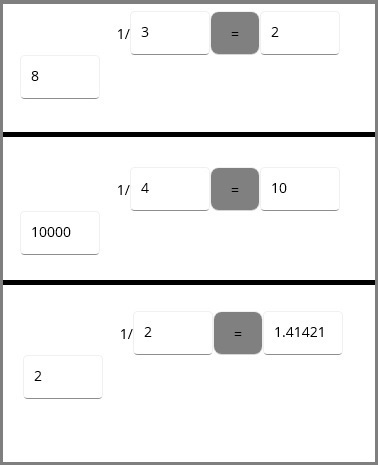 Finds a value that, when multiplied by itself a specific number of times, equals your original number.
Core Concepts
Radicand: The number under the root symbol (radical).
Index: The small number showing which root to take (like 3 for a cube root). If there is no number, it means a square root (index of 2).Reverse Power:
Roots undo exponents; for example, 5 × 5 = 25, so the square root of 25 is 5. That is, the 1/2 power of 25 is 5. In other words, the 2nd power of 5 is 25.
Logarithm Calculations
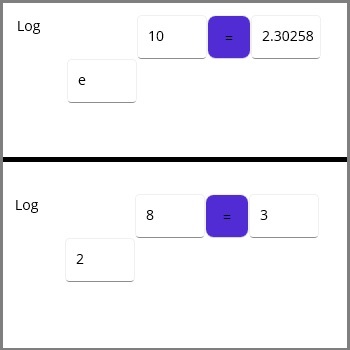 A logarithm is the opposite of a power. In other words, if we take a logarithm of a number, we undo an exponentiation.
Logarithms appear in all sorts of calculations in engineering and science, business and economics. Before the days of calculators they were used to assist in the process of multiplication by replacing the operation of multiplication by addition. Similarly, they enabled the operation of division to be replaced by subtraction. They remain important in other ways, one of which is that they provide the underlying theory of the logarithm function. This has applications in many fields, for example, the decibel scale in acoustics.
if x = a^n then loga x = n
Trigonometric Functions Calculations
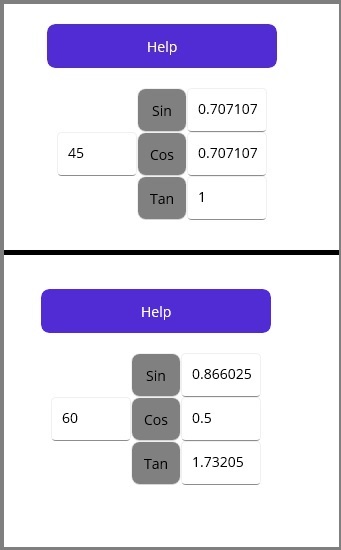 Trigonometric functions relate the angles of a right triangle to the ratios of its side lengths.
The Main Three Functions
Sine (sin): Ratio of the side opposite the angle to the hypotenuse (opposite / hypotenuse).
Cosine (cos): Ratio of the side adjacent to the angle to the hypotenuse (adjacent / hypotenuse).
Tangent (tan): Ratio of the opposite side to the adjacent side (opposite / adjancey or sin / cos).
Mnemonic: Use SOH-CAH-TOA to remember these three ratios.
Inverse Trigonometric Functions Calculations
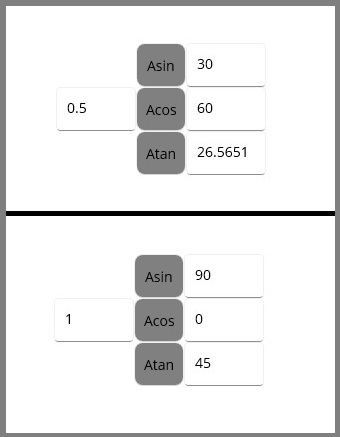 Inverse trigonometric functions take a ratio as an input and return the corresponding angle
There are particularly, three main inverse trig functions for each trigonometry ratio. The inverse of three important trigonometric functions are
Arcsine
Arccosine
Arctangent